

Latest News
Checking Boxes vs. Changing Outcomes: Goals for Nonprofit Leaders
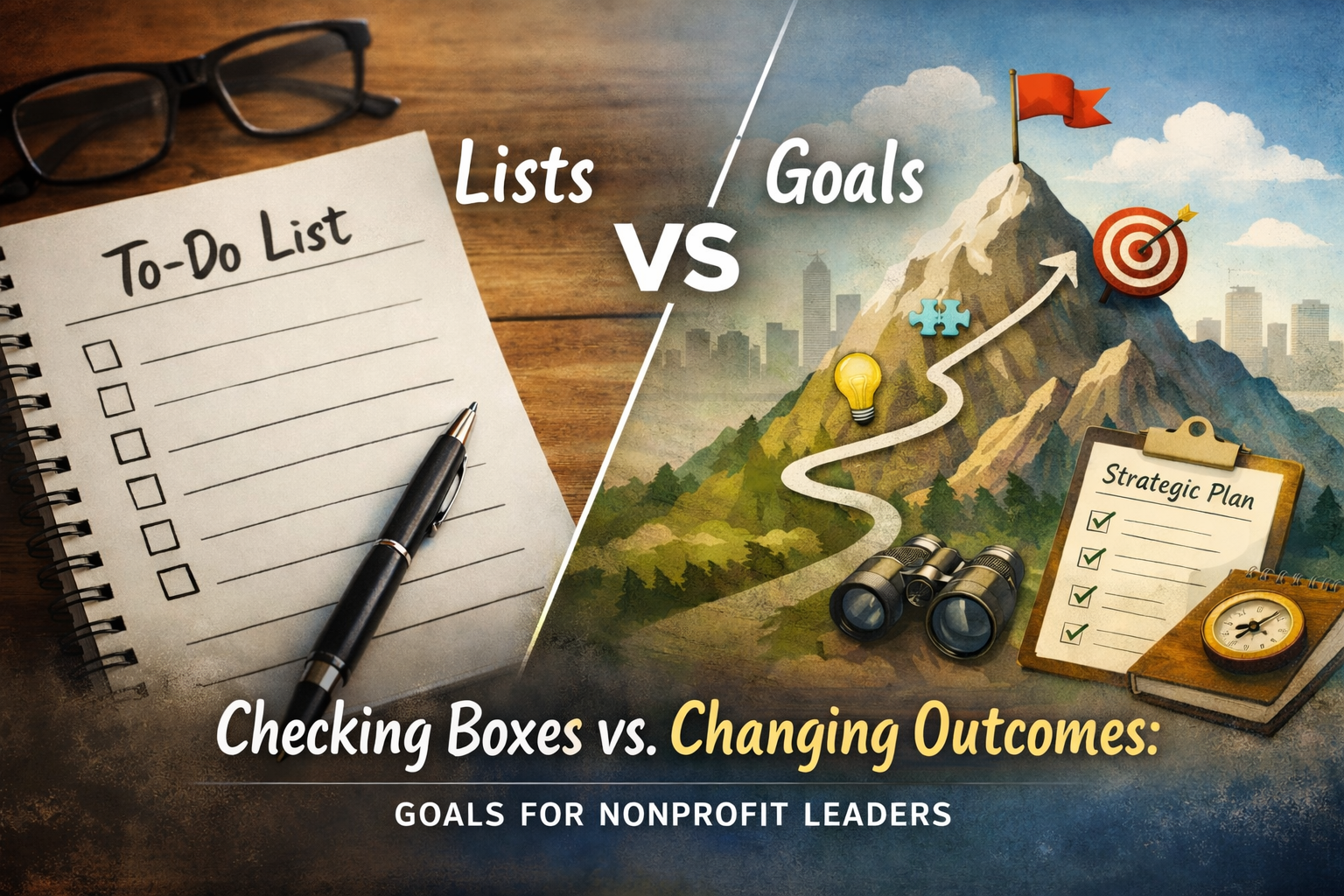
Here’s something I notice every January without fail. The calendar flips, inboxes fill back up, and suddenly everyone is making lists. To-do lists. Priority lists. “Top 10 things we need to fix this year” lists. Board retreat agendas that are really just lists with headings. Individually and organizationally, lists feel productive. They give us the comforting sense that we are organized, attentive, and ready to take on what’s ahead.
But making lists is not the same thing as setting goals.
For nonprofit leaders and board members, that distinction matters more than we often admit. Lists are reactive. Goals are intentional.
Lists are typically born out of urgency. They capture what feels pressing, overdue, or slightly uncomfortable. We need lists to keep the wheels turning and to ensure nothing slips through the cracks. But lists tend to reflect the present moment—what’s noisy, what’s broken, what someone asked for last week. Goals, on the other hand, ask a different question entirely: Where are we trying to go, and why does it matter?
At the beginning of the calendar year, it’s common to see organizations arrive at their first board meeting with a long list of initiatives for the year ahead. Launch this program. Update that policy. Recruit more board members. Improve fundraising. Strengthen communications. None of these are wrong. In fact, most of them are probably necessary.
But without thoughtful goal-setting, lists quietly take over. And when lists run the show, nonprofit leaders end up busy without being aligned.
Setting goals requires pause, reflection, and discipline. It requires deciding what not to prioritize. That’s uncomfortable work, especially where the needs are real and the stakes feel high. Yet this is precisely why intentional goals are so valuable.
In strategic planning, goals serve as anchors. A strategic plan that is essentially a long list of activities is unlikely to guide decision-making when tradeoffs arise—as they always do. Clear goals help leaders and boards assess opportunities through a shared lens: Does this move us closer to what we said mattered most? Or is it simply another good idea competing for limited time and resources?
The same is true for board development. Many boards maintain a standing list of improvements they’d like to make—better meetings, stronger fundraising participation, more diversity of perspectives, clearer roles. Again, all worthy aspirations. But when boards set intentional goals around their own development, the conversation shifts. Instead of vaguely wanting to “be better,” the board commits to becoming more effective in specific, measurable ways that support the organization’s mission and stage of growth.
Intentional goals also change how we think about staff development. A list of trainings to attend or skills to acquire can be helpful, but it doesn’t replace a goal-driven approach to growth. When leaders take the time to set thoughtful development goals with staff, they send a powerful message: development isn’t about checking boxes; it’s about preparing people to contribute meaningfully to where the organization is headed.
And then there’s individual professional development—perhaps the easiest place to default to lists. Books to read. Conferences to attend. Certifications to consider. Without goals, these lists can become a form of procrastination disguised as growth. With goals, professional development becomes intentional, focused, and aligned with both personal aspirations and organizational needs.
Goals create shared accountability.
When a board or leadership team sets goals together, they create a common reference point for progress, learning, and course correction. That shared ownership is difficult to achieve when everyone is simply working through their own list.
As the year gets underway, it’s worth asking a few simple but powerful questions—individually, as leadership teams, and as boards. Are we clear about what success looks like this year? Have we articulated goals that reflect our values, our strategy, and our capacity? Or are we simply hoping that checking enough items off the list will add up to meaningful progress?
Intentional goals don’t eliminate complexity or constraint. They don’t make nonprofit leadership easier. But they do make it clearer. And clarity is one of the most valuable resources we have.
Strategic Planning Day!
The development of a compelling strategic plan requires a team that is "all in." Honored to facilitate the kickoff retreat with the talented Board of Kentucky CASA Network today.
