

Latest News
Board Champions 101
Board leadership matters. And great board leadership takes practice.
I had the opportunity to facilitate Board Champions 101 with an incredible group of nonprofit executives and Board members from across the Evansville, Indiana region.
The discussion was highly interactive, candid, and focused on the real-world challenges—and opportunities—of building stronger, healthier, more effective boards. From clarifying roles to strengthening engagement, we explored practical ways Board members can become true champions for their organizations and missions.
A big thank you to the Welborn Foundation for sponsoring this important conversation and investing in nonprofit leadership across the region.
Great boards don’t happen by accident. They’re built intentionally.
Executive Evaluation That Builds Trust and Drives Results

When nonprofit boards discuss their governance responsibilities, they often focus on strategic planning, financial oversight, fundraising, and board recruitment. Yet one of the most important responsibilities of a board is sometimes the one that receives the least attention: supporting and evaluating the executive director or chief executive.
Unfortunately, many executive evaluations become annual administrative exercises that are rushed, uncomfortable, or disconnected from the organization's priorities. When done well, however, executive evaluation is much more than a performance review. It is an opportunity to strengthen trust, improve communication, reinforce accountability, and align leadership efforts with the organization's strategic goals.
At its core, the purpose of executive evaluation is development—not documentation.
Start With Strategy and Process
The most effective executive evaluations begin with clear expectations tied directly to the organization's strategy.
Too often, boards evaluate executives based on general impressions, recent events, or anecdotal feedback. Instead, performance should be measured against agreed-upon goals that support the organization's strategic plan, financial sustainability, fundraising priorities, and leadership expectations.
When evaluation criteria are aligned with organizational goals, the conversation becomes more objective and meaningful. The board and executive can focus on progress, challenges, and future priorities rather than personal opinions.
A healthy executive evaluation process follows a consistent framework. Conduct periodic check-ins throughout the year rather than waiting for an annual review. Gather input from both the board and the executive, hold a thoughtful evaluation discussion, and then establish future goals and development priorities.
Consistency builds fairness, transparency, and credibility while ensuring that expectations remain clear.
Avoid Common Evaluation Mistakes
Several common mistakes can undermine an otherwise well-intentioned evaluation process.
One of the most frequent is focusing only on recent events. An executive's performance should be evaluated across the entire review period, not just the last few months.
Another mistake is evaluating personality rather than performance. Boards should assess results, leadership behaviors, and organizational impact—not whether they personally prefer a particular leadership style.
Perhaps the most damaging mistake is surprising the executive during the evaluation meeting. Feedback should occur throughout the year so that the formal evaluation reflects an ongoing conversation rather than introducing concerns for the first time.
Boards also miss opportunities when they fail to connect the evaluation to strategic priorities or neglect to follow up on agreed-upon goals.
Include Executive Self-Assessment
One of the most valuable components of an executive evaluation is often the executive's own self-assessment.
Self-assessments encourage reflection, highlight accomplishments, identify challenges, and surface professional development needs. They also provide context that board members may not otherwise have.
Rather than viewing the evaluation as something being done to the executive, self-assessment helps create a collaborative discussion about leadership, organizational performance, and future success.
Consider the Value of an External Facilitator
Many organizations find that an external facilitator adds significant value to the executive evaluation process.
An experienced facilitator can help design the process, gather confidential feedback, identify common themes, and keep discussions focused on organizational priorities rather than individual opinions. Facilitators also bring objectivity and can help navigate sensitive conversations in a constructive manner.
Perhaps most importantly, an external facilitator can help boards reflect on their own effectiveness. Executive performance is often influenced by board leadership, communication, expectations, and support. A facilitator can help ensure the evaluation becomes a meaningful discussion about organizational success rather than simply a review of one individual's performance.
Remember: Evaluation Is a Two-Way Responsibility
One of the most overlooked truths about executive performance is that it is often influenced by board effectiveness.
While the executive leads day-to-day operations, the board establishes direction, provides resources, removes barriers, and offers both support and accountability.
As boards evaluate executive performance, they should also ask themselves:
Have we provided clear expectations?
Have we approved realistic goals?
Have we supplied sufficient resources?
Have we been effective partners?
These questions remind us that executive success is often a shared responsibility.
Make the Evaluation Meeting a Conversation
The evaluation meeting should not feel like a report card presentation.
Instead, it should be a conversation that strengthens partnership and builds alignment. Begin by discussing accomplishments and progress toward goals. Address challenges honestly and constructively. Explore future opportunities, development needs, and organizational priorities.
When handled thoughtfully, the evaluation process strengthens the relationship between the board and executive while positioning the organization for future success.
The Bottom Line
Healthy governance requires ongoing dialogue.
Executive evaluation should not be viewed as a once-a-year event but as part of a continuous process of communication, feedback, and partnership. When boards connect evaluation to strategy, provide regular feedback, incorporate self-reflection, and focus on development, they create a process that benefits both the executive and the organization.
Ultimately, the best executive evaluations do more than assess performance—they strengthen leadership, improve governance, and help advance the mission that everyone is working to achieve.
If your Board is ready to embrace its future, reach out to Nielsen Training and Consulting. Whether it is a conference presentation, an engaging Board retreat, or an impactful keynote, let’s equip your Board to succeed now and in the future.
Hearing Loss Association of America (HLAA) Board Retreat
Last week, I facilitated a thoughtful and engaging conversation with the Board of the Hearing Loss Association of America focused on the future of board leadership.
Together, we explored what it takes to build and sustain healthy boards in a rapidly changing environment—examining the critical roles of trust, healthy board culture, strong relationships, accountability, and leadership succession. The discussion highlighted how intentional governance practices create the foundation for boards to lead with confidence, adaptability, and impact.
HLAA is the nation’s leading organization representing people with hearing loss, providing support, education, advocacy, and resources to help individuals and their families live successfully with hearing loss.
The future of board leadership is built on trust, shared purpose, and a culture where every voice is heard.
CASA of Rock County Board Retreat
This week, I facilitated a Board and staff retreat with CASA of Rock County in Wisconsin. Together, we explored Board Champions: Habits and Practices of Healthy Boards, engaging in meaningful discussions about governance excellence, board culture, accountability, and the behaviors that help organizations thrive. We also spent time focused on strategic planning, identifying priorities and opportunities to strengthen the organization's impact in the years ahead.
CASA of Rock County's mission is to recruit, train, and support community volunteers who advocate for the best interests of children who have experienced abuse or neglect, ensuring that every child's voice is heard.
From Oversight to Foresight: The Future of Nonprofit Board Leadership

By 2035, nonprofit Board governance will look very different than it does today. Some of those changes are already underway. Others are just beginning to emerge. But one thing feels increasingly clear: the future nonprofit Board will not simply be a smaller version of the Boards we have now. It will require a fundamentally different mindset, different structures, and different expectations of leadership.
At the same time, it is important to recognize that many healthy, high-performing Boards are already modeling these practices today. While this article looks ahead to 2035, some organizations are already embracing more adaptive, strategic, and future-focused governance approaches right now. In many ways, the future of governance has already started.
For years, many nonprofit Boards have operated with traditions that were built for a slower-moving environment. Thick Board packets. Heavy committee structures. Long discussions focused on operational details rather than strategic leadership. In many organizations, Board service has often centered more on oversight and fiduciary responsibility than on adaptability, innovation, or community relevance.
That model is becoming less sustainable.
Nonprofit organizations today face an environment shaped by rapid technological change, increased donor expectations, workforce shifts, economic uncertainty, and rising demands for measurable impact. Communities expect organizations to respond faster. Funders want clearer evidence of outcomes. Staff leaders need Boards that can think strategically and act with agility rather than simply approve reports and review minutes.
The healthiest Boards of the future will not just govern organizations. They will help organizations navigate complexity.
One of the biggest shifts we will see is the move from transactional governance to generative governance. In other words, Boards will spend less time asking, “Did we follow the process?” and more time asking, “What future are we preparing for?”
That distinction matters.
Traditional governance is still essential. Fiduciary duties of care, loyalty, and obedience will always matter. Financial oversight will always matter. Legal compliance will always matter. But by 2035, high-performing Boards will recognize that governance is no longer just about protecting the organization from risk. It is also about helping organizations identify opportunity.
In fact, some of the strongest Boards today are already dedicating more meeting time to strategic discussion, generative thinking, and long-term planning rather than simply reviewing reports. They are creating agendas that prioritize mission impact, organizational resilience, and future readiness.
Boards will increasingly engage in strategic foresight conversations. They will spend more time discussing demographic changes, emerging technologies, volunteer engagement trends, public trust, cybersecurity, and shifting community needs. Scenario planning may become a standard governance practice rather than an occasional retreat exercise.
Artificial intelligence will also reshape governance in ways we are only beginning to understand. By 2035, many Board members will likely receive AI-generated dashboards that summarize financial trends, predict fundraising patterns, flag operational risks, and even identify potential governance blind spots before meetings occur.
Ironically, as technology becomes more sophisticated, the human side of governance may become even more important.
The Boards that thrive will be the ones that maintain authentic relationships, healthy culture, thoughtful judgment, and mission-centered decision making. AI may help summarize information, but it cannot replace wisdom, empathy, or values-based leadership.
We will also likely see significant changes in Board composition and recruitment.
Historically, many nonprofit Boards have recruited members primarily based on influence, wealth, professional status, or community visibility. While those qualities may still have value, the future Board will need a much broader range of perspectives and lived experiences.
Many organizations are already beginning to rethink how they recruit and engage Board members. Some are shifting away from “who do we know?” toward “what perspectives and competencies do we need around the table?” That evolution will likely continue over the next decade.
Board service itself may also become more flexible.
Many nonprofits still expect volunteers to commit to multi-year terms, monthly meetings, multiple committees, and extensive time demands. That model can unintentionally limit participation from younger professionals, working parents, and community leaders with demanding schedules.
Future Boards may move toward more modular engagement structures. Shorter terms. Project-based task forces. Virtual governance participation. Skills-based advisory councils. Hybrid committee models. Organizations that adapt governance structures to modern volunteer realities will likely have a much easier time attracting talented leaders.
Another major shift will involve the relationship between Boards and CEOs.
Historically, some Boards have viewed governance through a lens of oversight and control. But by 2035, the strongest Board-CEO partnerships will likely operate with far greater clarity around roles, trust, and shared leadership. Healthy governance will require strong accountability while also creating space for innovation and executive leadership.
Boards that micromanage may increasingly struggle to retain talented CEOs. On the other hand, Boards that disengage entirely will also create organizational risk. The future will require balance.
Perhaps most importantly, nonprofit governance in 2035 will require courage.
Courage to ask difficult questions.
Courage to rethink outdated traditions.
Courage to confront inequities.
Courage to adapt before crisis forces change.
And courage to lead organizations through uncertainty without losing sight of mission and values.
The nonprofit sector has always existed to meet human needs and strengthen communities. That mission will not change. But the environment surrounding nonprofits absolutely will.
The future Board will not succeed simply because it has good intentions. It will succeed because it is informed, adaptive, strategic, inclusive, and willing to evolve.
And while 2035 may feel far away, some of the most effective nonprofit Boards are already demonstrating what this future can look like. They are embracing strategic governance, investing in Board culture, engaging in generative conversations, and leading with adaptability rather than tradition alone.
In many ways, the future of nonprofit governance is not really about technology, structures, or trends. It is about whether Boards are willing to become the kind of leadership bodies that the future will require.
The organizations that embrace that challenge now will likely be the ones best positioned to thrive in 2035 and beyond.
If your Board is ready to embrace its future, reach out to Nielsen Training and Consulting. Whether it is a conference presentation, an engaging Board retreat, or an impactful keynote, let’s equip your Board to succeed now and in the future.
Leading Beyond the Chair: The Enduring Influence of a Former Board President
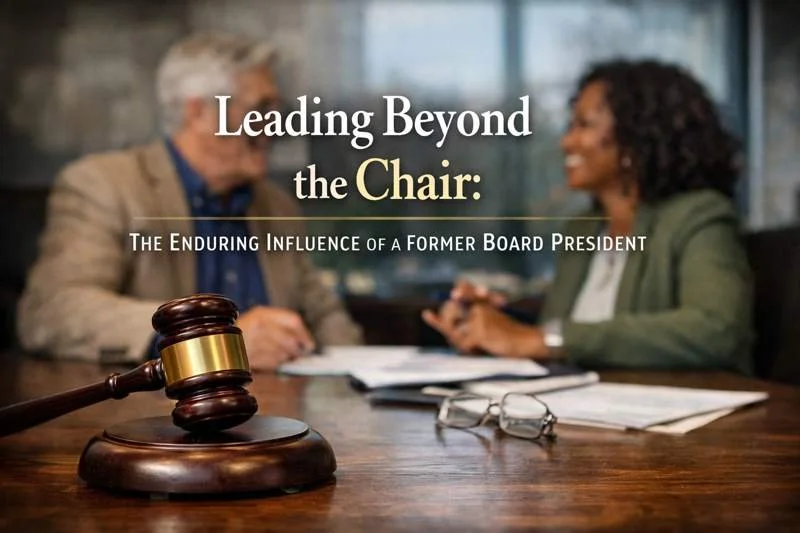
When a nonprofit Board President’s term comes to an end, it can feel a bit like stepping off a moving train. For many, the role has been all-consuming—setting agendas, partnering closely with the CEO, and navigating challenges. So what comes next?
In my experience working with nonprofit boards across the country, the most effective past presidents don’t step away—they step into a different kind of leadership. One that is often quieter, but no less impactful. The transition from Board President to past president (formally or informally) is a pivotal moment, not just for the individual, but for the health and continuity of the organization.
Here are several valuable roles a former Board President can play to continue adding meaningful value:
1. Trusted Advisor to the New Board President
One of the most important—and sometimes underutilized—roles is serving as a thought partner to the incoming Board President. This doesn’t mean hovering or second-guessing decisions. It means being available.
A new president is often navigating steep learning curves: managing board dynamics, building a relationship with the CEO, and finding their own leadership voice. A former president can provide context, institutional memory, and a sounding board when questions arise.
The key here is balance. The most effective past presidents resist the urge to “do” and instead focus on supporting the new leader in their approach. It’s less about continuity of style and more about continuity of strength.
2. Steward of Institutional Knowledge
Every organization has history—decisions made, lessons learned, relationships built. Much of this lives informally in the minds of long-serving leaders.
Former Board Presidents are uniquely positioned to help preserve and share that institutional knowledge. Whether it’s helping explain the “why” behind a past strategic pivot or providing background on long-standing partnerships, this perspective can prevent the organization from reinventing the wheel—or repeating past mistakes.
This role is especially valuable during times of transition, such as a new CEO, a strategic planning process, or significant growth.
3. Champion of Governance Excellence
After serving as Board President, individuals often have a deeper appreciation for what strong governance really looks like—and where gaps may exist.
This creates an opportunity to contribute as a governance champion. That might include:
Supporting board self-assessment efforts
Mentoring newer board members on roles and responsibilities
Helping refine committee structures or board practices
Encouraging a culture of accountability and engagement
Because they’ve “sat in the seat,” former presidents often have credibility to raise governance questions in a constructive and forward-looking way.
4. Strategic Thought Partner
Freed from the day-to-day responsibilities of leading the board, former presidents can often engage more fully in strategic thinking.
They can ask big-picture questions, connect dots across initiatives, and help ensure the organization stays focused on its long-term vision. In many cases, they can serve as valuable contributors to strategic planning processes—bringing both historical context and a systems-level perspective.
This is particularly powerful when paired with humility: offering insight without dominating the conversation.
5. Ambassador and Relationship Builder
Board Presidents often build strong external relationships—with donors, community partners, and key stakeholders. Those relationships don’t need to end when the term does.
Former presidents can continue to serve as ambassadors for the organization—opening doors, maintaining connections, and supporting fundraising efforts. In fact, without the formal responsibilities of the presidency, they may have more flexibility to lean into this role.
Their credibility and familiarity with the organization’s mission and impact can make them especially effective advocates.
6. Mentor to Emerging Leaders
Healthy boards are always thinking about leadership development and succession. Former Board Presidents can play a critical role in mentoring future leaders within the board.
This might include:
Coaching committee chairs
Encouraging and developing potential future officers
Sharing insights about leadership challenges and opportunities
By investing in others, former presidents help ensure a strong leadership pipeline and a more resilient organization over time.
7. Model of Graceful Transition
Finally, one of the most powerful roles a former Board President can play is simply modeling what a healthy leadership transition looks like.
Letting go of authority, supporting new leadership, and continuing to serve with purpose—but without attachment to position—sets a tone for the entire board. It reinforces that leadership is about service, not status.
I often tell boards: people are always watching how leaders exit roles just as much as how they enter them. A thoughtful, intentional transition can strengthen trust and set the stage for future success.
Stepping down as Board President is not an ending—it’s an evolution. When approached with intention, it creates space for new leaders to emerge while allowing experienced leaders to continue contributing in meaningful ways.
The most effective nonprofit boards recognize this and create pathways for past presidents to stay engaged—leveraging their experience, perspective, and commitment to the mission.
Because at the end of the day, strong governance isn’t about any one role. It’s about a collective commitment to stewarding the organization forward—together.
Governance and Strategy With San Diego Botanic Garden

There’s something powerful about connecting how a board governs with where an organization is going.
One of the most impactful moves in strategic planning is integrating a Board Self-Assessment into the process. It grounds the strategy in reality—clarifying strengths, surfacing gaps, and ensuring the board is truly equipped to steward the vision ahead. Strategy doesn’t just live on paper—it lives through governance.
Grateful for the opportunity to facilitate a two-day leadership retreat with San Diego Botanic Garden, where we brought together board governance and strategic planning in a meaningful, integrated way. The conversations were thoughtful, candid, and forward-looking—exactly what strong governance requires.
And the setting? Absolutely stunning. The Garden itself is a reminder of what intentional cultivation can create over time. If you haven’t visited, it’s well worth experiencing.
Don’t Forget the Wisdom in the Room: Engaging Emeritus Board Members Thoughtfully

Most nonprofit leaders I know spend a lot of time thinking about who’s next—the next board member, the next committee chair, the next generation of leadership. That’s healthy. But sometimes, in the rush forward, organizations unintentionally leave behind a group that still has a great deal to offer: emeritus board members.
When engaged well, emeritus board members can be an extraordinary asset. When engaged poorly—or not defined at all—they can create confusion, frustration, and blurred lines of authority. Like most things in governance, the difference is intentionality.
So let’s talk about who emeritus board members are, why they matter, and what nonprofits should be careful about as they invite these seasoned leaders to stay connected.
What Is an Emeritus Board Member, Anyway?
An emeritus board member is typically a former board member who has completed their term of service but is invited to maintain a formal, ongoing relationship with the organization. Many nonprofits include a short provision in their bylaws authorizing the board to designate “Directors Emeritus” (or similar title). This status is usually honorary and non-voting .
Emeritus roles are often extended to individuals who have given long or particularly impactful service—founders, past chairs, major champions of the mission, or board members who played a critical role during a defining moment in the organization’s history.
What emeritus board members are not is “board members without term limits” or “shadow directors.” They are no longer part of the governing body, and that distinction matters.
The Value Emeritus Members Can Bring
When structured well, emeritus board members can add value in several meaningful ways.
First, they bring institutional memory. Nonprofits turn over leadership regularly, and that’s a good thing. But with turnover comes the risk of repeating old mistakes or forgetting hard-won lessons. Emeritus members often remember the “why” behind major decisions, the context of past partnerships, and the evolution of the mission over time.
Second, they can serve as trusted ambassadors. Emeritus members are often deeply connected in the community. They can open doors, make introductions, and advocate for the organization in spaces current board members may not yet reach. In fundraising, this can be especially powerful—particularly when an emeritus member is comfortable making thank-you calls, attending cultivation events, or lending credibility to a campaign.
Third, they can mentor current board and executive leaders. New board chairs and CEOs often benefit from a confidential sounding board—someone who understands the organization but is no longer in the hot seat. Emeritus members can provide perspective without politics if expectations are clear.
Finally, emeritus status can be a meaningful way to honor service. It communicates gratitude and respect, reinforcing a culture that values leadership, contribution, and long-term commitment to the mission.
Where Nonprofits Need to Be Careful
All of that upside comes with some important cautions.
The biggest risk is role confusion. If emeritus board members attend board meetings without clarity, weigh in on decisions, or communicate direction to staff, governance lines can blur quickly. Staff may not know whose guidance to follow. Board members may feel undermined. CEOs may feel like they have multiple bosses.
Another common pitfall is creating emeritus status without an exit ramp. Emeritus should not be automatic or indefinite by default. Not every departing board member needs—or wants—this role, and that’s okay. Organizations should be selective and clear about expectations, term length (if any), and purpose.
There’s also the risk of nostalgia overpowering strategy. Institutional memory is valuable, but it should inform forward-looking decisions—not anchor the organization to “the way we’ve always done it.” Emeritus members need to respect that the organization will evolve beyond their tenure.
Best Practices for Engaging Emeritus Board Members
Healthy engagement starts with clarity. Put the role in writing. Define whether emeritus members are voting or non-voting (they almost always should be non-voting), whether they attend board meetings, and how they are expected to contribute.
Give them meaningful, mission-aligned ways to stay involved—ambassadorship, mentoring, fundraising support, special projects—without inserting them into governance.
Finally, remember that emeritus status is a relationship, not a reward shelf. Like any relationship, it works best with communication, boundaries, and mutual respect.
When nonprofits engage emeritus board members thoughtfully, they don’t just honor the past—they strengthen the future. And in a sector built on relationships, wisdom doesn’t expire just because a term ends.
Walden School Board Retreat

Healthy Boards not only plan for the present, they explore possibilities for the future with curiosity. It was a pleasure to facilitate a long-range planning retreat with the dedicated Board of Directors of Walden School, an independent K-12 school in Louisville, KY. Thoughtful, mission-driven leadership like theirs is the foundation of lasting impact. Grateful for the opportunity to support their commitment to excellence and innovation in education! 🌟📚
Ethics in Nonprofit Governance: Upholding Integrity and Accountability

🌟 Just wrapped up leading a session on "Ethics in Nonprofit Governance: Upholding Integrity and Accountability"— a timely and important conversation on how nonprofit leaders can build trust, ensure transparency, and navigate ethical challenges with integrity.
Grateful to have partnered with the Federal Bar Association and myLawCLE to bring this session to life. It's always an honor to engage with legal and nonprofit professionals who are committed to doing good—ethically and effectively.
Board Champions 2025 at Welborn Baptist Foundation

In partnership with Welborn Baptist Foundation, I was honored to lead a session last week in Evansville, Indiana on Board Champions: Habits and Practices of Healthy Boards. I was so impressed with the talent and engagement of the Board members and nonprofit executives in the room as we had a fun and thoroughly interactive discussion!
Reach out to us if your organization or foundation is interested in bringing Board Champions to your community.
What is Your Board's Standard? 🤔

“The standard you walk past is the standard you accept.”
Lieutenant General David Lindsay Morrison, former Chief of the Australian Army, made this statement in response to inappropriate behavior within the military, but it has always stuck with me because of its application to other arenas, including the nonprofit Board room.
Board members are the owners – the standard bearers – of their team. They shape the culture of the team and set the standard for its performance. Board members who fulfill expectations and are accountable for their commitments contribute to a high standard of performance. Likewise, Board members who witness a problem or behavior and fail to address it are implicitly accepting it as the new norm.
Healthy Boards reflect on the standard they are setting in many areas, including:
1. Setting Organizational Culture
Nonprofit boards play a critical role in shaping the culture and ethics of the organization. If board members allow low standards—whether it’s poor governance, lack of accountability, or ineffective fundraising practices—they are implicitly accepting those standards as the new baseline. Over time, this can erode the organization's mission, reputation, and ability to deliver on its goals.
2. Accountability
Board members have a fiduciary duty to ensure that the nonprofit operates efficiently, ethically, and in accordance with its mission. If they overlook financial mismanagement, unaddressed conflicts of interest, or ineffective leadership, they are condoning those behaviors. By walking past these issues, boards risk harming the nonprofit’s long-term sustainability and undermining public trust.
3. Leadership and Influence
Boards set the tone for executive leadership. If nonprofit leaders see that the board tolerates substandard behavior or practices, they may feel emboldened to act in ways that don't align with the organization's values. Boards should be proactive in holding leadership accountable, providing guidance, and ensuring that the nonprofit's values are reflected in every aspect of its operation.
4. Risk Management
Boards are responsible for identifying and managing risks, including legal, financial, and reputational risks. By walking past risky behavior or inadequate systems, they expose the organization to unnecessary dangers. Nonprofit boards must be vigilant and prepared to step in when things go wrong, before the situation worsens or becomes irreparable.
5. Setting Expectations
One of the most important roles of a nonprofit board is to set clear expectations for performance. If board members fail to address underperformance or missed opportunities, they send a message that mediocrity is acceptable. This can have a ripple effect throughout the organization, from staff members to volunteers, and can ultimately diminish the nonprofit’s impact.
6. Building a Culture of Excellence
Boards should actively cultivate a culture of excellence by setting high standards, regularly reviewing performance, and ensuring that resources are used efficiently and effectively. By doing so, they help the nonprofit fulfill its mission in the most impactful way possible. If board members allow mediocrity, they reduce the nonprofit's ability to achieve its goals and make a difference in the community.
7. Encouraging Transparency
Effective boards encourage openness and create an environment where transparency is the norm.
What is your Board’s standard?
If your Board is ready to evaluate or elevate its standard, let’s talk!
DirectEmployers Association Board Retreat

Associations play a vital role in bringing people and groups together around common interests and shared values. I enjoyed facilitating a dynamic discussion on Board governance with the talented Board team from DirectEmployers Association. This Association provides superior HR technology and expert guidance that can be leveraged by employers, State workforce personnel, and other partners.
Board Champions: Hudson Ferris

Nonprofits thrive when leaders and those who support them learn with and from each other. It is one of the things I love most about working with nonprofits — being part of a learning community driven by curiosity. I recently presented a skill building workshop on Board governance for the talented team from Hudson Ferris. In the workshop, we discussed topics including:
💡Defining expectations for Board members
💡Identifying the skills, talents, and perspectives needed on the Board
💡Leveraging committees and meetings effectively
💡Navigating boundaries between Board and staff
It was an exciting and interactive discussion and I thank the team from Hudson Ferris for inviting me to share my thoughts. Hudson Ferris is a boutique fundraising firm based in New York City with 50 years of professional development experience.
NTCA Summer Symposium - Strategies for Effective Board Meetings

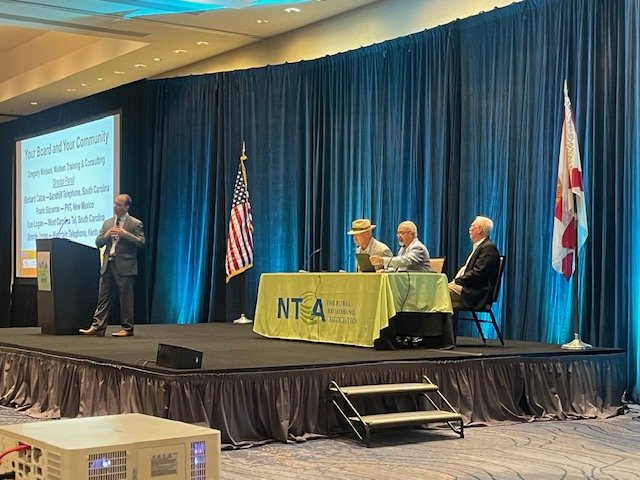
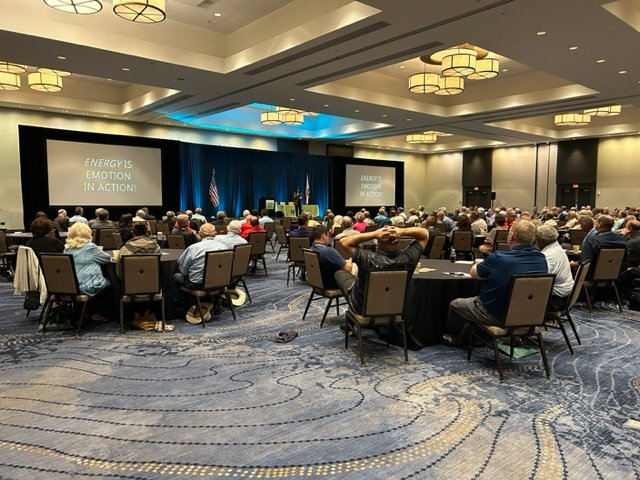
Board meetings are most effective with a thoughtfully planned agenda centered around mission-focused strategic discussions and decisions. I so enjoyed sharing thoughts on strategies for effective Board meetings at the NTCA Summer Symposium in Savannah this week. As an added bonus, I had the opportunity to facilitate and engaging and informative panel discussion on Board governance with 3 talented Board members.

Nonprofit CEO & Board Leadership Virtual Conference

Professional development is critical to the success of all leaders. I invite you to join me at the upcoming Nonprofit CEO & Board Leadership Virtual Conference on February 22, 2024 presented by DCM Associates. I will be co-facilitating a panel discussion with my colleague Jay Weisman on “Strengthening Your Nonprofit Board.” Other sessions of the virtual conference include:
CEO Succession Planning – The CEO’s Perspective
CEO Succession Planning – The Board’s Perspective
Strengthening Your Leadership Team
Click below for more information and I look forward to you joining me on February 22 for a great day of learning and development!
NTC and Kentucky CASA Network Partnership

Healthy nonprofits are built on strong foundations. Two critical components of a strong foundation are an informed, engaged Board of Directors and a compelling vision for the organization supported by actionable goals and strategies.
I am thrilled to announce an innovative partnership between NTC and Kentucky CASA Network (KCN) to develop dynamic Boards and actionable strategic plans with CASA programs across the State of Kentucky. With support from KCN, over the next 12-18 months NTC will have the opportunity to work with CASA programs across the State -- facilitating Board retreats and strategic plannings projects. Our vision is to amplify the great work being done in these programs by providing resources to elevate Board governance and develop actionable goals and strategies.
“The KCN recognizes that in order to deliver high quality advocacy services to abused and neglected children, we must build and sustain highly effective CASA programs across the Commonwealth. This all starts with strong board governance to provide this critical infrastructure and support. We are excited to work with NTC to further enhance our work as we move towards the vision of every child in Kentucky having access to a CASA volunteer.”
Andrea Bruns - CEO, Kentucky CASA Network
The Kentucky CASA Network provides ongoing development, training, technical assistance, and resources to local CASA programs across the Commonwealth. Currently, the Kentucky CASA Network is an association of 21 local programs, covering 92 Kentucky counties, which served 3,538 abused and neglected children in 2022. The KCN also advocates for the needs of CASA programs with industry stakeholders in the Capitol and throughout the state. The CASA programs in Kentucky are part of a larger national network.

NTCA Summer Symposium - Jacksonville

Thank you NTCA -- The Rural Broadband Association — for the invitation to speak at the first session of your Summer Symposium in Jacksonville, Florida. I throughly enjoyed moderating a panel discussion on Board governance and community engagement and leading sessions on developing healthy, engaged, and inspired Board members. See you next week in Minneapolis for the second session!
NTCA Conference

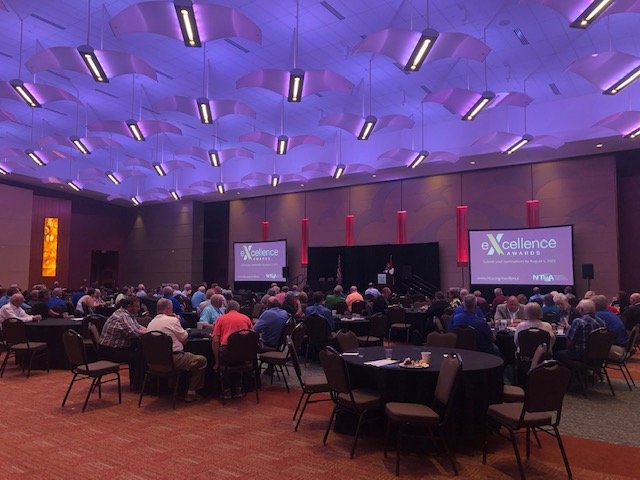
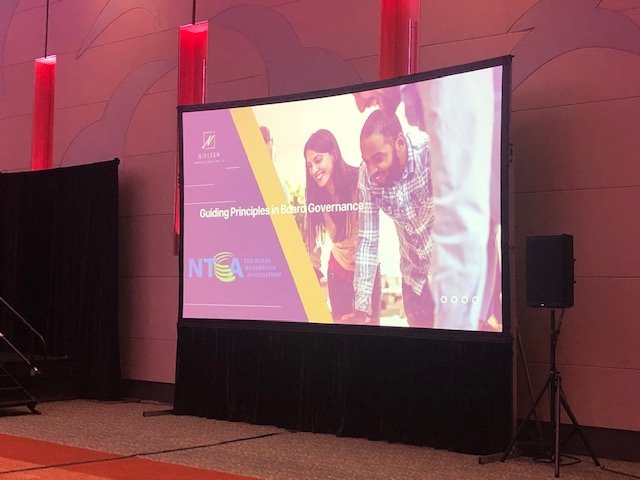
Thoroughly enjoyed speaking this week at the Summer Symposium of NTCA–The Rural Broadband Association. I enjoyed meeting and interacting with so many talented leaders while speaking on Principles in Board Governance as well as Strategic Planning for Boards. NTCA is building a better broadband future for rural America. NTCA’s members build and deliver broadband connectivity and operate essential services in rural and small-town communities across the U.S.
Jewish Family & Career Services Board Retreat

Enjoyed leading part 1 of a 2-part Board retreat with the talented leaders of Jewish Family & Career Services. JFCS expands possibilities for each person and every family to meet life’s challenges with confidence.